

Part 4: Problems With Using the Biblical Account Verbatim, Unquestioningly, While Simultaneously Ignoring its Glaring Internal Inconsistencies and Contradictions
Now that we have established the timeline and which pharaohs we are dealing with let us explore the issues with the historical and factual possibilities involved in the story and the contradictions and impossibilities encountered. We have already seen just a few of the innumerable problems with accepting the biblical account verbatim. Dates are wrong and irreconcilable with actual facts, number of years specified between happenings are inconsistent and irreconcilable, names of people cannot be correct or if they are then the whole account is completely false, etc. We shall now explore more of these issues.
Another minor problem with the story as contained in the bible is the physical and archaeological evidence that conclusively shows that the term “pharaoh” in Egyptian means “Great House” and that its original usage was NOT that of a title for a head of state but rather a term used for the household or court of the ruling family. Calling the king of Egypt “Pharaoh” would be like calling the Queen of England “Buckingham Palace” or “Windsor” rather than “Queen” since these are the respective names for her court and her household/dynastic name. This “pharaoh” term is used for the FIRST TIME as a title for, and in reference to, a ruler in person for Shoshenq I, founder of the 22nd Dynasty, who ruled from 943-922 BCE. This fact means that no Egyptian ruler of the entire period from Joseph’s entry through the entire time the Israelites “dwelt in the land” up until well after the time of the Exodus was ever called “pharaoh.” Rather, they were called the equivalent of the more modern term “king/queen” and “lord” (“nswt” or “ity” being the most common forms of those words). Further, the word “pharaoh” is a hebrew-ized pronunciation of the Egyptian word “per-aa” (the previously mentioned “Great House”) and so not even a “real” Egyptian word.
So much for the Bible being true or accurate in any sense there. Any author writing at, or even relatively close to, the timeline of the Exodus would not have called the ruler of Egypt “Pharaoh.” This fact means that the EARLIEST date of the writing of the Exodus account could NOT have occurred prior to 943 BCE…which is more than 110 years AFTER the establishment of the Kingdom of Israel. This is probably nothing more than a writer at a later period of time using a new term to retroactively apply to previous rulers even though the term was never used for them by their own society at the time of their rule.
The largest and most glaring problem with the biblical story of Joseph, the Exodus, and the Promised Land, is that for the entire duration of the New Kingdom Period, Egypt controlled all of the area of the ancient Land of Canaan. From about 1457 BC BCE right up until the Late Bronze Age Collapse (LBAC hereafter), Canaan was a province under the direct military, civil, and economic control of Egypt. The LBAC began in areas of the Mediterranean and Middle East in the late 1200’s BCE and reached its full effect by the middle 11th century BCE. Therefore the date range we have determined based on biblical math DOES NOT WORK. Israel cannot “escape” slavery in Egypt, wander in Egyptian territory for 40 years without being caught, and then enter, conquer, and settle in Egyptian territory/Land of Canaan. They COULD NOT have possibly entered Canaan until 1215 BCE at the EARLIEST date…only 165 years before the anointing of King Saul and only 249 years before the beginning of the construction of the First Temple.
What this means for our analysis is that the Israelites could not have escaped from Egypt and then subsequently established their own kingdom in Canaan unless Egypt was no longer in control of the area around Canaan. We know that the Kingdom of Israel under the rule of Saul was established by 1050 BCE. During the LBAC, many cities in the area of Canaan were destroyed, which COULD reasonably coincide with the “conquest” of Canaan by the Israelites, IF the problems of the dates and timelines could be resolved (which they cannot be) especially since there is evidence that the Egyptians were still in control of large parts of the area during much of the period. Full Egyptian control was not ended until sometime after 1215 BCE.
The rise of new empires after the LBAC, brought renewed conquest of Canaan by other entities. The Neo-Assyrian Empire rose from the ashes of the Middle Assyrian Empire and around 806 BCE, thundered through Canaan conquering everything until they had reconquered the entire area of the former Assyrian Empire, culminating with the complete conquest of all of the Egyptian Empire’s former land by 671 BCE. ALL of the history of the Kingdom of Israel is book-ended by these two kingdoms: The Egyptian New Kingdom and the Neo-Assyrian Empire. The only time period the Exodus could have happened is just before, or in the early part of, the LBAC when the Egyptian Empire’s power in Canaan was fading. Our window is approximately 165 years between Egyptian loss of control and the known establishment of the Kingdom of Israel by 1050 BCE.
This 165 year window does not leave ANY time for the biblically claimed intervening period between the Exodus and the ascension of King Saul. The shortest number of the three different biblically claimed sets of years is 440; the longest is 600. These numbers are just too large to fit into that 165 year window.
So the biblical claimed timeline is completely and utterly wrong about how much time was between the conquest and the First Temple. It is physically not possible for the Israelites to have escaped Egypt, wandered for 40 years, conquered Canaan (over a 7 year span), lived there for another 440-600 years, and then build the temple. Canaan was only unoccupied by the Egyptian New Kingdom Empire AFTER 1215 BCE and King Saul was on the throne 165 years later.
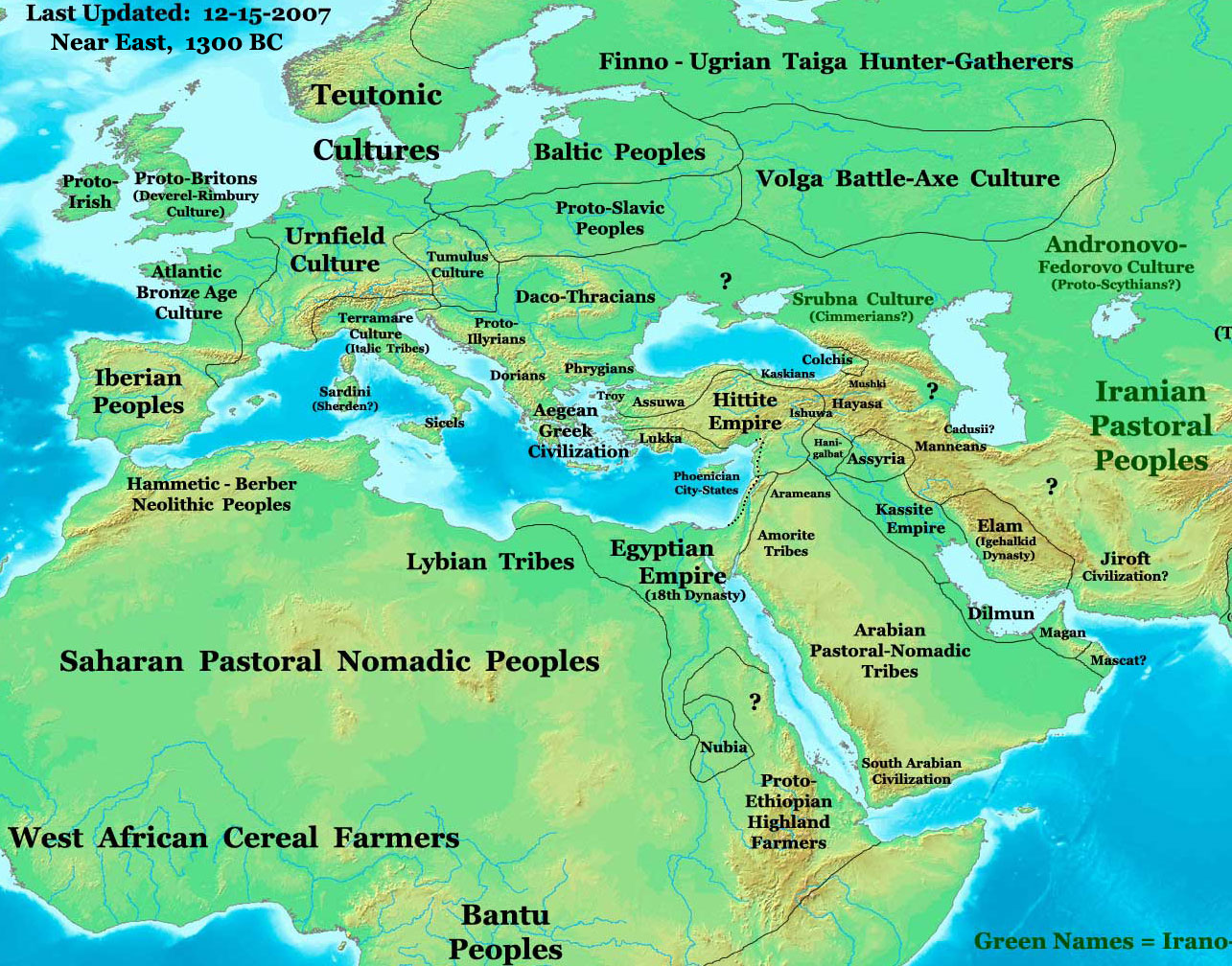
The Borders of Egypt under Hatshepsut & Thutmose III
To finalize this door slamming shut on the possibilities of the story of the Exodus as recounted in the Bible, archaeologists have conclusively shown that rather than an “outside” population coming in and taking over the region of Canaan and asserting their control in the power vacuum left by the Egyptian Empire, the Israelites were a native and local hill tribe of Semitic Canaanites who gradually expanded into the region from the mountainous terrain in the “less urban” areas after the Egyptians withdrew. Evidence for this fact comes through numerous forms but the most interesting is that these hill tribes show evidence of abstinence from pork while their Semitic Canaanite neighbors/cousins are still eating pork. The archaeological record further shows that rather than a large scale or widespread “conquest” type of take-over, the spread of these pork averse hill tribe Canaanites was relatively peaceful and was more along the lines of a cultural takeover rather than military.
The towns in the area that DO show evidence of conquest by military force rather than cultural absorption, were actually conquered by the Sea-People AKA the Philistines AKA the Phoenicians NOT the Israelites.
More evidence comes from the fact that archaeologists have conclusively shown that pork was consumed by ALL the Semitic tribes of the ancient middle and near east until approximately 1000 BCE. When the archaeological record shows that some groups began to not farm pork. So the biblical assertion of a Halal or Kosher dietary restriction handed down by a deity cannot be true unless said deity waited until about 1000 BCE…or just before, right at or just after the time of the founding of the nation of Israel.
 Ranticus Rants
Reblogged this on Die Goldene Landschaft.
LikeLike