

Part 3: Which Pharaohs are We Dealing With?
The KJV states that the pharaoh Joseph met with was ruler of all the land of Egypt (Genesis 41:41). The African Pharaohs of the Middle Kingdom, the Second Intermediate, and the New Kingdom Periods, all ruled the entirety of the land of Egypt (and the entire eastern Mediterranean coast including all of Canaan) at several points in time and for most of their various dynasties’ history, while the Asiatic Hyksos Pharaohs NEVER controlled more of Egypt than just the Nile delta area (Lower Egypt).
There are competing theories as to why the Hyksos could be the pharaohs that Joseph and the Israelites dealt with, but if we are analyzing the bible story itself the Hyksos are ruled out by the biblical account alone. Couple this evidence with modern scientific knowledge of the archaeology and history of Egypt and the ancient cultures involved and our confidence in this position becomes nearly rock solid. These issues will be discussed in more detail later in this post.
Using the previously established dates of Joseph’s entry into Egypt as a slave there are five possibilities for the pharaoh at that time. They are:
- Nebhetepre Mentuhotep II, 2061–2010 BCE, 6th ruler of the 11th Dynasty.
- Sankhkare Mentuhotep II, 2010 BC – 1998 BCE, 7th ruler of the 11th Dynasty.
- Khakaure Senusret III, 1878 – 1839 BCE, 5th ruler of the 12th Dynasty.
- Amenemhat III, 1860–1814 BCE, 6th ruler of the 12th Dynasty.
- Amenemhat IV, 1814-1805 BCE, 7th ruler of the 12th Dynasty.
These five pharaohs are all of the Middle Kingdom Period, with the Twelfth Dynasty being the last dynasty of the Middle Kingdom Period. The next period in Egyptian history is the Second Intermediate Period, where several things happened that will help us narrow down our timeline and possibilities. Among these things are two crucial items: 1) a major relocation of the nation-state’s capital city and 2) the invasion/conquest of Lower Egypt’s Nile Delta area by the Asiatic Hyksos people. Where the pharaoh in question ruled, is a pertinent point which we shall get to momentarily. Let’s continue with our other main points in this section first. The first point we shall use in establishing which of these five pharaohs Joseph may have met, is taken directly from the account in Genesis.
Genesis 41:14
“Then Pharaoh sent and called Joseph, and they brought him hastily out of the dungeon: and he shaved himself, and changed his raiment, and came in unto Pharaoh.”
The KJV account here makes clear that Joseph shaved and changed his clothes. Why is this significant? Because, the African Pharaohs were known to be culturally averse to body hair to the extreme extent that royalty, nobility, and especially priests shaved their entire bodies. This ritual was often performed as frequently as every other day, and included the removal of all body hair, including even eyebrows and eyelashes. Although beards represented power and sometimes divinity to the Egyptians, for the sitting pharaoh, they used a gold and jewel encrusted false beard to represent this “beardly” power, rather than actually growing out their facial hair. This cultural trend began quite early in the Old Kingdom period and extended unbroken for the entire line of African Pharaohs, right up to the period of the conquest of Egypt in 332 BCE by Alexander the Great. The ONLY exception to this cultural norm were the Hyksos Pharaohs.
This tidbit of information serves to help us clarify whether the pharaoh that Joseph met was an African or an Asiatic Hyksos. The Hyksos Pharaohs were of Middle-Eastern rather than African origination, and all of the male dominated cultures in Middle-Eastern area, including all of the Semitic tribes, were kind of obsessed (huge understatement) with growing thick, luxuriant, manly beards. To the Egyptians’ Middle Eastern neighbors, beards were a symbol of manliness, power, and virility. All of the men in these societies grew their beards as long, thick, and luxuriant as they possibly could. The Asiatic Hyksos pharaohs were no different than the rest of their Middle Eastern neighbors and Semitic cousins. Therefore, if we are to accept the biblical account as factual or even remotely connected to actual history, the pharaoh Joseph met with could NOT have been one of the Asiatic Hyksos Pharaohs otherwise he wouldn’t have gone to the trouble of shaving.
Read More About Egyptian Body Hair Rituals Here
The next point in establishing which pharaoh Joseph may have met is that the ruling pharaoh, whose dream Joseph interpreted, was ruler of all the land of Egypt according to the Biblical account. (All emphasis added by me).
Exodus 41:8
“And it came to pass in the morning that his spirit was troubled; and he sent and called for ALL THE MAGICIANS OF EGYPT, and ALL THE WISE MEN THEREOF: and Pharaoh told them his dream; but there was none that could interpret them unto Pharaoh.”
Exodus 41:41
“And Pharaoh said unto Joseph, See, I have set thee over ALL THE LAND OF EGYPT.”
These are only two selected verses from this chapter, but the entire chapter of Exodus 41 continually, repeatedly, and frequently refers to the entire land of Egypt. It would be a very interesting, and nonsensical literary choice for any author to refer to “all the land of Egypt” numerous times in a single chapter if the land of Egypt was under divided rule by two different factions both acting as “pharaohs.” This would have been a very salient, relevant, and important point for the author(s) to make since the biblical authors are exceedingly concerned with who was in political and military control of even the smallest areas. This point becomes even more important when you know that the “land of Egypt” in biblical terms was long understood as BOTH Upper and Lower Egypt since the “Two Lands,” and their respective crowns and regalia, were first united around 3000 BCE. This had been military an political fact for more than a thousand years by the EARLIEST date Joseph could have possibly been sold into slavery in Egypt. Any author or historian of the time period would have specified that the pharaoh was ruler of Upper or Lower Egypt or both. In this case it appears that the authors DID specify that the pharaoh Joseph supposedly met was ruler of ALL of Egypt.
The next point that provides us further evidence is shown by the fact that the Second Intermediate Period Asiatic Hyksos worshiped Set/Seth, God of the desert, storms, disorder, violence, and foreigners, as their chief god while the Old , Middle, and New Kingdom Egyptians worshiped Re/Ra, God of the Sun as their chief god. The biblical account specifies that Joseph’s new wife, given to him by the Pharaoh, was the daughter of the Priest of On (Genesis 41:45). The City of On is known by its more commonly used Greek name: Heliopolis, or City of the Sun (now a suburb of modern day Cairo). So the priest whose daughter Joseph married was a priest of the Sun God rather than Set/Seth. If Joseph had rendered beneficial aid to pharaoh in interpreting his dreams, why would the pharaoh then marry him to the daughter of a priest from a branch of religion that was not his own preferred branch?
All of this evidence coupled with all of the other biblical account evidence makes clear that Joseph could only be meeting an African Pharaoh and not an Asiatic Hyksos Pharaoh as both dynasties controlled the entire surrounding Nile Delta area of modern-day Cairo/biblical On, but only one group controlled the region outside that area at the same time as they controlled the Nile Delta region, only one group practiced the cultural aversion to body hair and obsession with cleanliness that would have motivated Joseph to shave and change his clothes, AND only one of the two groups worshiped the Sun. For these reasons I think it is safe to eliminate the Hyksos pharaohs of the Second Intermediate Period as possible pharaohs personally known to Joseph.
Further evidence for which of the pharaohs Joseph may have met comes from knowing where the capital city of each ruling dynasty was located. The 11th Dynasty capital was at Thebes, far south from the Nile Delta area in Upper Egypt. The 12th Dynasty capital was at Faiyum, just southwest of the point of the delta, and the Hyksos pharaohs capital was at Avaris in the eastern marshes of the delta. These locations rule out the 11th Dynasty as the pharaohs Joseph may have met, since their capital was so far south that there is no reason to have married Joseph off to the daughter of a priest from a city more than 300 miles away. I think we can safely eliminate the 11th Dynasty pharaohs.
Map of Ancient Egypt Locations

As we determined earlier there are five possibilities for the pharaoh of the time of Joseph based on all of our possible timeline calculations, but we have now eliminated the two pharaohs of the 11th Dynasty from our list, leaving us with only three pharaohs from the 12th Dynasty:
- Khakaure Senusret III, 1878 – 1839 BCE, 5th ruler of the 12th Dynasty.
- Amenemhat III, 1860–1814 BCE, 6th ruler of the 12th Dynasty.
- Amenemhat IV, 1814-1805 BCE, 7th ruler of the 12th Dynasty
Using the three pharaohs we have narrowed it down to, and the earliest and latest date that the Israelites COULD have re-entered Canaan and begun their conquest we derive the range of 1408-1365 BCE. All three of the pharaohs listed are African rather than Hyksos pharaohs, all three were worshipers of the Sun god, Ra/Re, all three ruled the combined kingdom of both Upper and Lower Egypt, and slavery was practiced during the reign of all three of them, so we cannot use these biblical statements to narrow our list down any further. Let’s move on to the pharaohs of the Exodus and see if that can help us clarify our timeline any.
We have established a list of possible pharaohs at the time of Joseph and now we have narrowed it down to three. Now we need to identify the possible pharaohs ruling at the time of the Exodus. The first three possible dates of the Exodus fall within the Egyptian Second Intermediate Period, when the Nile Delta area was conquered by the Hyksos. The ruler of the first possible Exodus date is unknown for certain to archaeologists and historians but is speculated to be Sakir-Har. As mentioned previously, during this period Egypt was under divided rule and engaged in civil war for 100 years, from 1650-1550 BCE. Due to known internal conflicts, it is theoretically possible, that during this period Egypt may have lost control of some of its furthest areas of domination (i.e. Canaan). However, there is evidence to suggest that although there was some border area incursions, that Canaan was never truly outside the control of Egypt. There are records that show Ramesses I ordering his son and successor, Seti I, to recoup and consolidate Egypt’s borderlands in Syria, north of Canaan. This indicates that Canaanite region was never out of the sphere of Egypt’s control. Further, under Ramesses II (The Great) the Egyptian army expanded its border to the largest extent that Egypt ever saw in its entire history. This rules out Ramesses the Great as the ruler of the Exodus time period. Our possible list of pharaohs of the Exodus is thus:
- Sakir-Har, Unknown dates, Hyksos pharaoh of the 15th Dynasty
- Khyan, 1610-1580 BCE, Hyksos pharaoh of the 15th Dynasty
- Apepi, 1576-1540 BCE, Hyksos pharaoh of the 15th Dynasty
- Hatshepsut, 1479–1458 BCE, 5th pharaoh (pharaoh-ess) of the 18th Dynasty
- Thutmose III, 1479–1425 BCE, 6th pharaoh of the 18th Dynasty
- Amenhotep II, 1425–1398 BCE, 7th pharaoh of the 18th Dynasty
- Amenhotep III, 1388–1350 BC, 9th pharaoh of the 18th Dynasty
This list for potential pharaohs is in direct contradiction to the biblical account which names the pharaoh as Ramesses. Here we see yet another of the Bible’s innumerable internal contradictions and false assertions. Exodus 1:11 explicitly states that the Israelite slaves built the city of Ramses (which is archaeologically and historically known to have been started by Ramesses I in the early 1200’s BCE and completed by his grandson, Ramesses II, in the late 1200’s BCE according to the stellae found within the city itself commemorating its construction). Either we can use the biblical account to establish dates (which dates directly contradict the possibility of Ramesses as the pharaoh of the Exodus) OR we can assume that Ramesses was the pharaoh of the Exodus. We cannot do both since they are irreconcilable. However, assuming Ramesses was king at the time of the Exodus 1] completely obliterates the possibility of the Exodus ever happening at all (because of the problem of Egypt owning/controlling all of Canaan during the entirety of his reign 2] would push the building of the temple from 966 BCE to the date range of 766-566 BCE which is simply not possible. The year the First Temple began to be built is one of our two hard and fast dates. Let’s list the problems Ramesses as the Exodus pharaoh causes:
- IF we assume the Exodus happened under ANY of the pharaohs named Ramesses as the Bible claims, AND we assume the Bible is correct (or even in the ballpark) about the timeline and intervening years between events we have used to date the Exodus during this period, these two assumptions push the founding date of the Kingdom of Israel forward in time way too far. Remember, the Israelites supposedly escaped Egypt, wandered in the desert for 40 years, took 7 years to conquer Canaan, and then spent somewhere between 440-593 years living under the rule of the Judges until Saul was raised to the throne. The EARLIEST year ANY pharaoh named Ramesses began his rule was in 1292 BCE. Therefore the math looks like this: 1292-40-7-440=805 BCE which is 245 years AFTER the reign of King Saul is known to have begun. Further, as you can see by the map immediately below this post, the Kingdom of Israel had already split into the separate kingdoms of Israel and Judah by that date. The Kingdom did not split until after the reign of Solomon, during the rule of his son Rehoboam (the 4th King of Israel) which began in 930 BCE. So the known hard facts and simple math tell you that the biblical assertion of a pharaoh named Ramesses as the ruler at the time of the Exodus is patently and completely false. Its just plain impossible, no matter how you adjust the timeline. Either the pharaoh was named Ramesses and all the other statements in the bible story are wrong or the timeline and duration numbers for various events are correct and the pharaoh’s name is wrong. They are irreconcilable.
Map of Ancient Near Eastern Kingdoms Around 800 BCE

- The first mention of slaves in Egypt in ANY source is during the 18th Dynasty, which began around 1550 BCE. Using the Old Testament’s stated duration of 400-430 years of residence in Egypt before the Exodus AND using the known ruling dates of ANY pharaoh named Ramesses, puts the date of Joseph’s entry as a slave into Egypt significantly prior to the 1550 BCE date and into the date range of 1722-1692 BCE. Therefore, the Bible can be correct about the name of the pharaoh at the time of the Exodus OR the length of time the Israelites were supposedly Egyptian slaves but NOT BOTH. Yet another of the Bible’s innumerable internal contradictions.
- Ramesses II (The Great) ONLY fits the biblical description if we consider the length of his reign. The problem still remains that Egypt under Ramesses II controlled all of the area of and around the so-called “Promised Land.” Since we have narrowed the ONLY possible timeline down to a very specific, very narrow, 165 year window after Egypt lost control of the area around Canaan as the date that Israel could become an independent nation, (discussed further shortly), this precludes Ramesses II from being the pharaoh of the Exodus.
- Ramesses is indirectly mentioned by name as the pharaoh of the Exodus time in the biblical account. However, this cannot be even remotely accurate, since the biblical city of Ramesses (actually Pi-Ramesses) was started by Ramesses I and completed by his grandson, Ramses II (the Great). Ramesses I began his reign around 1295 BCE and construction on this city occurred from between 1295 through 1213 BCE, when Ramesses II died. These dates are 81 years apart. Since we have relatively firmly established the timeline of the Exodus in the 260 year period between 1636-1376 BCE, as the ONLY possible period in which it could have occurred (based on the Bible’s own timeline), none of the 11 separate pharaohs named Ramesses could have been the pharaoh of the Exodus. Ramesses I (the first of 11 pharaohs of this name) ascended to the throne in 1292 BCE, 84 years AFTER the LATEST possible date of the Exodus. Ramesses XI (the last pharaoh of the name) died about 1076 BCE, 300 years AFTER the LATEST possible date of the Exodus.
- All of these facts together mean that the author of the biblical story of the Israelites in Egypt was probably just using the name of one of the most famous pharaohs (or series of pharaohs) in history (at that time and even in our time), as a convenient bad-guy. This would probably be creditable to the fact that since the oldest portions of the Old Testament/Pentateuch were not first written down until the 600’s BCE…700 years AFTER the latest possible date of the Exodus and more than 400 years after the last pharaoh named Ramesses died and the “Ramesside Era” of ancient Egypt was a fairly “recent” memory.
For ALL of the Egyptian New Kingdom time period, from 1550 BCE through 1215 BCE and for MOST of the time between 1215 BCE and its end in 1076 BCE , the entire area of the land of Canaan was part of the Egyptian Empire either directly or as numerous smaller vassal states directly controlled by Egypt. The furthest north extent of the border during this period was at Kadesh/Qadesh in modern day Syria, just north of the northeastern corner of the current borders of Lebanon. This further reinforces the fact that no re-entry into Canaan by the Israelites is possible until after Egypt has lost control of the area, which COULD NOT have possibly happened until sometime after 1215 BCE.
Ramses II fought a great battle against the Hittite Empire during his reign. This battle took place on the border between the two empires, north of Canaan, near the town of Kadesh (modern day Qadesh, in south-western Syria near the north-east border with Lebanon). Further border battles between the 20th Dynasty Egyptian pharaohs and the Hittites and later Assyrians were fought in this same area, and are commemorated on several Egyptian stellae found in the area that conclusively show complete Egyptian control of the area until the late 1200’s BCE and even moderate amounts of dominion until as late as 1076 BCE.
Map of the Egyptian and Hittite Empires circa 1300 BCE
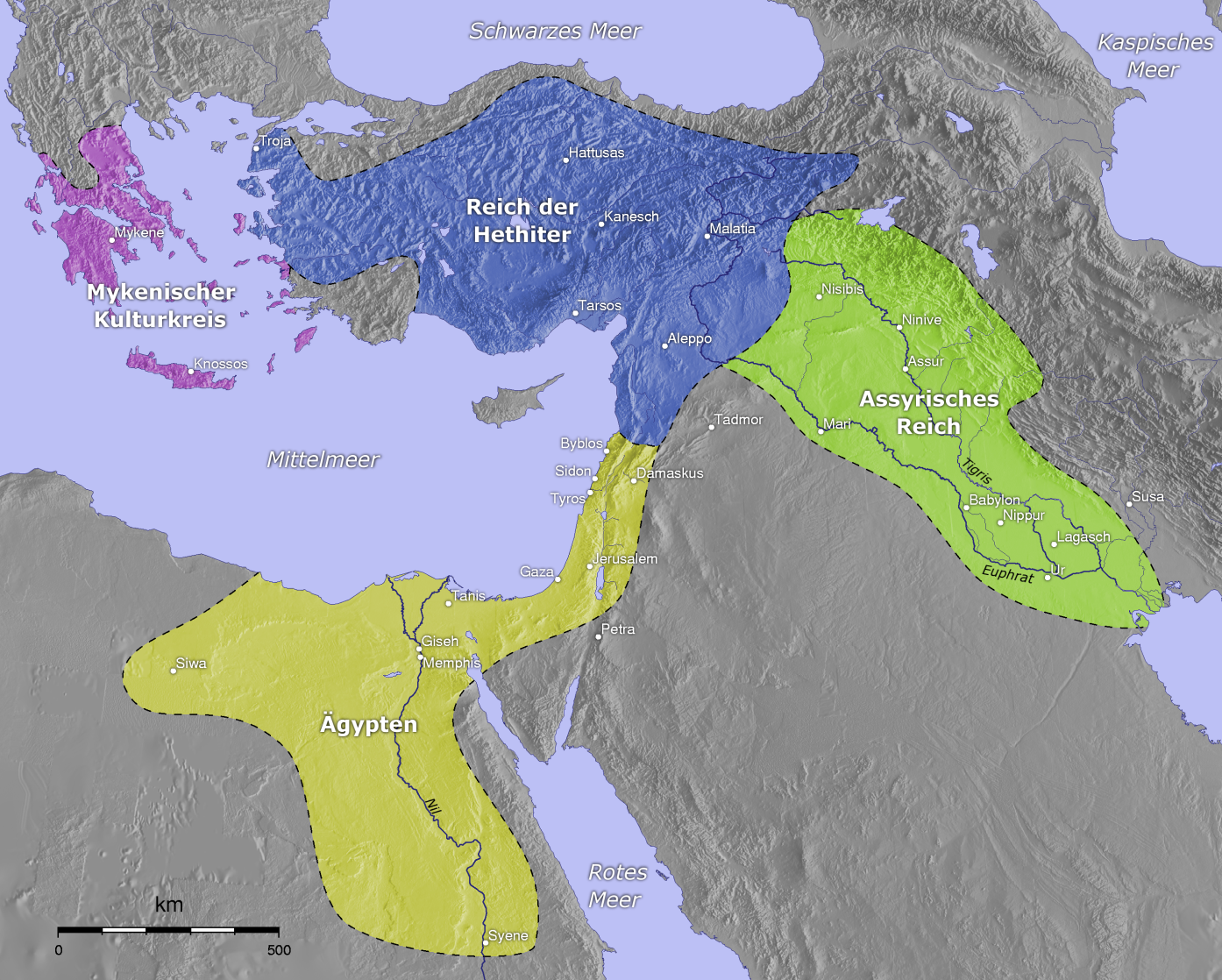
The Israelites did not become a nation-state in their own right until the rise of Saul in the 11th Century BCE (around 1050 BCE). Prior to the Israelites becoming a nation-state in their own right the Egyptian and Hittite Empires shared a common border in modern-day Syria and Lebanon, north of Damascus. Not until the Egyptian and Hittite Empires began to collapse, during the later portion of the Egyptian New Kingdom Period, were the Israelites able to establish any kind of self-rule. This first symptoms of this collapse BEGAN after the end of the reign of Ramesses II (in 1213 BCE) and was not fully seen until the middle to end of the reign of Smendes (1077–1052 BCE).
The known facts are that there was virtually no slavery in the Old Kingdom Period of Egypt. Slavery did not start until sometime in the Middle Kingdom Period. Thus, Joseph could not have possibly been a slave prior to the middle of the Middle Kingdom Period. And finally, the Kingdom of Israel is known to have been firmly established by 1050 BCE.
So, in the following bullets the initial known and well established historical fact (F) or biblical statement (BS, yes i recognize the humor in that) leads us to the subsequent logical and reasonable deductions (D) in each bullet:
- (F) Slavery was not practiced in Egypt during the Old Kingdom Period which ended in 2055 BCE. (D) So Joseph could NOT have been a slave earlier than this date.
- (BS) Joseph married the daughter of the head priest of the Egyptian Sun God Ra, not the daughter of the head priest of Set. (D) This rules out all of the Hyksos pharaohs and the 100 year time period of their dominion of Lower Egypt from 1650-1550 BCE as the period when Joseph could have been enslaved.
- (BS) Joseph shaved and changed his clothes which means he could not have met an Western Asiatic, Semitic, Hyksos Pharaoh. (D) This again rules out all of the Hyksos pharaohs and the hundred year time period of their dominion of Lower Egypt from 1650-1550 BCE.
- (BS) If we accept the Bible’s SMALLEST stated intervening time of 440 years between the building of the temple and the start of the Exodus, then (D1) the Exodus HAD to have started no later than 1446 BCE. (D2) Which pushes the enslavement of Joseph back to AT LEAST 1846-1876 BCE. (D3) This deduction rules out the latter two dates of Joseph’s possible entry into Egypt as a slave and since we had already ruled out the first two dates it leaves us with only the middle two: 1876 & 1846 BCE. Which leaves us with two possible pharaohs that Joseph may have known:
- Khakaure Senusret III, 1878 – 1839 BCE, 5th ruler of the 12th Dynasty. Read More About Senusret III Here
- Amenemhat III, 1860–1814 BCE, 6th ruler of the 12th Dynasty. Read More About Amenemhat III Here
- (F) This new information gives us a more narrowed date range and two possible pharaohs for the Exodus:
- (D) 1478-1430
- Hatshepsut, 1479–1458 BCE, 5th pharaoh (pharaoh-ess) of the 18th Dynasty. Read More About Hatshepsut Here
- Thutmose III, 1479–1425 BCE, 6th pharaoh of the 18th Dynasty. Read More About Thutmose III Here
- (D) 1478-1430
- (BS) There is no mention of the female of the Exodus being a female so (D1) we are left with Thutmose III as the only possible pharaoh of the Exodus. (D2) Which further narrows the pharaoh of Joseph down also, leaving us with Amenemhat III.
 Ranticus Rants